Grading often feels like a single decision: What grade does this student get? In reality, grading is the visible outcome of a system of design choices—what counts as evidence, how learning is interpreted over time, how performance is described, how ratings become grades, and how those grades influence credit, advancement, and graduation.
When learning is understood as developmental rather than fixed, those choices become more visible—and more consequential.
This Zone invites you to investigate grading and advancement as an interconnected system. You’ll examine both the principles that ground competency-based grading and the structural decisions that shape how grades function in real schools. Along the way, you’ll explore models, tradeoffs, and policy levers that influence what grades ultimately communicate—and what they make possible for learners.
This section is organized into two parts:
Grading Principles
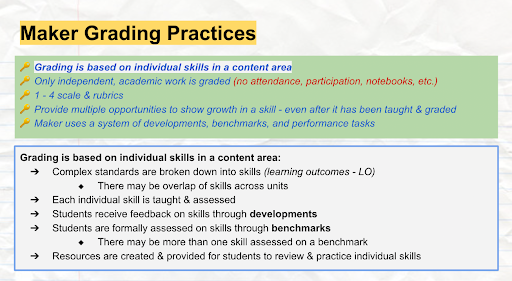
You’ll examine six guiding principles that ground competency-based grading. These principles help clarify what we value—accuracy, equity, growth, agency—and provide a shared language for evaluating grading practices without assuming a single “right” approach.Designing Graded Systems: From Evidence to Advancement
You’ll investigate how classroom grading practices connect to broader advancement and crediting structures. From what counts as evidence of competency to how graduation requirements are structured, you’ll examine the decision points, models, and policies that shape learner outcomes.
You don’t need to move through these cards in order. Start where the tension feels most real in your context. The goal isn’t to prescribe a perfect system. It’s to help you see the landscape clearly—so that when you move into design, your choices are intentional, informed, and aligned with what matters most.